
Choosing a Commercial Property Inspector: Costs, Credentials & Tips
By Fred Rodrigues, Certified Master Inspector and Member of Certified Commercial Property Inspectors Association, with thousands of inspections completed in Florida.
Article Recap: Your Guide to Commercial Property Inspections
This comprehensive guide equips you with the knowledge to confidently navigate commercial property inspections. Here’s what you’ll discover:
- Inspector’s Role & Scope: Understand what commercial property inspectors evaluate and how their findings integrate into due diligence.
- Key Qualifications: Learn about essential licenses, industry certifications (CCPIA, InterNACHI), and the importance of property-specific experience.
- The Inspection Process: A step-by-step breakdown from initial booking to final report delivery and follow-up.
- Cost Factors: Insights into how property size, type, location, and pricing models influence inspection fees.
- Hiring Best Practices: Practical tips for finding, vetting, and verifying local inspectors, including what questions to ask.
- Report Interpretation: How to read and utilize the inspection report for negotiations, budgeting, and informed decision-making.
Finding a qualified commercial property inspector is crucial for due diligence, helping stakeholders identify risks and budget for repairs. This guide covers the inspector’s role, qualifications, process, costs, and how to use the report for informed real estate decisions.
What Does a Commercial Property Inspector Do? Understanding Their Role and Inspection Scope
A commercial property inspector evaluates visible building systems to identify defects, safety concerns, and maintenance issues. Their role is objective observation, functional testing, and documenting findings in a report for negotiation and budgeting. Inspections are broad but non-invasive; specialists are often recommended for complex issues.
Commercial inspections commonly evaluate core systems and areas to reveal defects, compliance gaps, and life-safety concerns. Inspectors assess structural elements, roofing, mechanical, electrical, plumbing, fire protection, building envelope, and site drainage. They document condition and operational status. For complex systems like elevators, specialists are recommended.
Common systems evaluated in a commercial inspection include:
- HVAC system: visual condition, age indicators, basic operation, and presence of service panels.
- Electrical system: service capacity, visible wiring issues, and panel labeling.
- Plumbing: main lines, visible leaks, water heater condition, and drainage.
- Roofing and building envelope: membrane condition, flashing, and signs of water ingress.
- Structural and site: visible structural members, foundations, grading, and drainage patterns.
A commercial inspection provides actionable data for legal, environmental, and financial due diligence, quantifying transactional risk and shaping negotiation strategy. Findings inform repair budgeting and reserve estimations, influencing price adjustments or escrow holdbacks. The report serves as a technical record and negotiation tool for evidence-based decisions.
What Qualifications and Certifications Should You Look for in a Commercial Property Inspector?
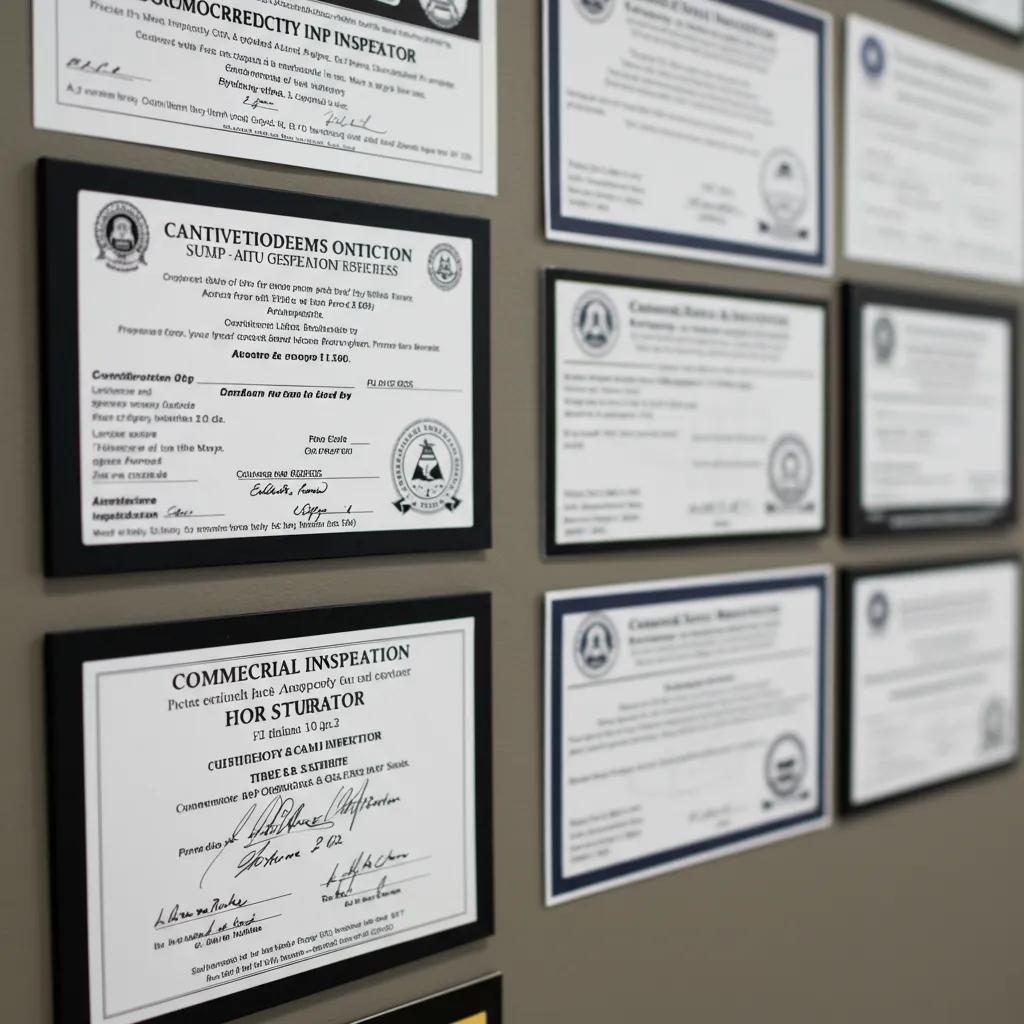
A competent commercial inspector needs licenses, industry certifications, and experience. State licensing ensures legal authority. Certifications (CCPIA, InterNACHI) indicate specialized knowledge and adherence to standards. Experience with specific property types (retail, office, industrial) is vital due to unique systems. Always verify insurance (E&O) and request sample reports.
Below is a comparison of common certifications and what they practically mean for someone hiring an inspector.
Verify certifications by asking for documentation and explaining requirements. CCPIA signals commercial training; InterNACHI shows broad practice. ASTM E2018 familiarity is valuable for institutional transactions. Request sample reports and references to assess real-world application.
Property-specific experience reduces risk. Ask for examples of inspections on similar properties and sample reports showing depth of analysis for relevant systems. Use targeted questions to assess their fit.
How Does the Commercial Property Inspection Process Work? Step-by-Step from Booking to Report
A clear inspection process aligns expectations. It involves scoping, contracting, on-site data collection, functional testing, specialist engagements, report compilation, and final delivery. Understanding these stages helps buyers schedule access and ensure detailed reports for stakeholders. Clear scope definition improves turnaround.
Key stages clarify responsibilities and outputs. Use this checklist:
- Pre-inspection scoping and agreement defining systems, access, and specialist needs.
- On-site walkthrough with data collection, non-invasive testing, and basic functional checks.
- Specialist engagement for elevators, environmental, structural, or MEP systems as needed.
- Drafting of findings with photos, severity ratings, and recommendations for remedial actions.
- Quality review and compilation of the final report with executive summary and appendices.
- Client delivery, Q&A, and scheduling of follow-up specialist assessments if requested.
- Post-report support for negotiation or remediation planning.
Reports are typically searchable PDFs or via cloud portals, with an executive summary, system findings, prioritized recommendations, and photos. Lenders may expect PCA-style summaries. Use the report for negotiation, specialist assessments, and post-closing remediation. Request a sample report during hiring.
What Factors Influence Commercial Property Inspection Costs? Understanding Pricing Models and Fees
Inspection costs depend on property size, complexity, scope, specialist needs, and market factors. Larger square footage, complex MEP systems, access challenges, and multi-building sites increase costs. Travel, security, and permits also add fees. Pricing models (per-square-foot, flat fee, hourly) offer trade-offs. Request detailed line-item quotes for fair comparison.
Property size and type scale inspection time; industrial/healthcare facilities often require more hours. Urban locations may add travel fees. Age and condition influence time spent documenting defects. Specialist testing adds discrete fees. Understanding these drivers helps budget planning.
What are common pricing models for commercial property inspections?
When comparing quotes, ask for a breakdown of base inspection hours, travel, report production, and specialist fees to normalize proposals. A 10,000 sq ft office differs from a 100,000 sq ft warehouse with multiple rooftop units. Request line-item quotes and clarify assumptions (e.g., roof cores, attic access) to avoid surprise charges and ensure apples-to-apples comparisons.
Per-square-foot pricing is simple but can underprice complex buildings. Flat fees offer clarity for defined deliverables. Hourly models provide flexibility for complex properties. Require a written scope of work and change-order process to avoid scope creep.
How to Find and Hire the Right Commercial Property Inspector Near You? Practical Tips and Resources
Find qualified local inspectors via industry directories, broker referrals, and local searches. Vet candidates by verifying licenses, certifications, insurance, and sample reports. Ask for references on similar property types. Compare bids by ensuring each proposal defines scope, deliverables, timeline, and specialist inclusions. Key actions: written quotes, sample reports, insurance confirmation, signed scope of work.
Verification checklist and questions to use when hiring an inspector:
- Verify licensing and certifications through state boards or certifying bodies.
- Request proof of errors & omissions (E&O) and general liability insurance limits.
- Ask for three references for similar property types and recent sample reports.
- Confirm expected turnaround time, deliverable format, and whether specialist testing is included.
- Require a written scope, fee schedule, and change-order policy before engagement.
Ask for license numbers and certificate copies, then confirm with issuing bodies. Request insurance certificates (E&O, general liability) showing current and adequate coverage. For credentials, ask for course completion evidence and how standards are applied. This ensures qualifications match technical needs.
Online reviews and referrals offer signals about communication and report usability, but corroborate with sample reports and references. Look for patterns mentioning responsiveness and usefulness in negotiations. Contact references about how findings were used. Combine reputation with document review for reliable vetting.
What Should You Expect in a Commercial Property Inspection Report? Key Components and Interpretation Tips
A useful report combines an executive summary, system-by-system detail, annotated photographs, prioritized recommendations, and documented limitations. This structure helps stakeholders triage issues and plan next steps. It identifies critical safety items, quantifies deferred maintenance, and recommends specialist follow-up. Reports vary (PCA vs. operational checklists) but enable negotiation, budgeting, and planning. Request a sample report during vetting.
Reports commonly include an executive summary, system-specific findings, photographic documentation, recommendations, and appendices. The table below shows typical sections and their use:
Use the report as a decision-support document: identify safety-critical items, quantify mid-term capital expenses to adjust offers, and commission specialist assessments for risks. Options include accepting as-is, negotiating price/repairs, conditioning sale on remediation, or walking away. Use clear, evidence-backed language in requests to sellers.
Frequently Asked Questions
1. What should I look for when hiring a commercial property inspector?
Prioritize qualifications, experience, and certifications (state licenses, CCPIA/InterNACHI). Assess experience with your property type. Request references and sample reports for thoroughness and clarity.
2. How long does a commercial property inspection typically take?
Duration varies by property size, complexity, and scope, typically a few hours to a full day. Larger or complex sites may take longer. Discuss expected timelines with your inspector during scoping.
3. What are the common limitations of a commercial property inspection?
Inspections are non-invasive, limited to visible, accessible areas. Concealed defects may go undetected. Inspectors often recommend specialist evaluations for complex systems. Understand these limits for realistic expectations and additional assessments.
4. How can I use the inspection report in negotiations?
The report provides documented evidence. Use the executive summary to highlight critical defects for price reductions, seller-funded repairs, or escrow holdbacks. Reference specific findings to support your position and propose conditional remedies.
5. What follow-up actions should I take after receiving the inspection report?
Review thoroughly: prioritize safety-critical items, assess mid-term capital expenses for offer adjustments or escrows. Commission specialist assessments for concealed risks. Options include accepting, negotiating, conditioning sale, or walking away.
6. Are there specific questions I should ask during the inspection process?
Inquire about experience with similar properties, documentation methods, and issue prioritization. Clarify limitations and specialist recommendations. These questions gauge expertise and ensure a comprehensive assessment.
7. How do I interpret the severity ratings in the inspection report?
Ratings (critical, major, minor) indicate urgency. Critical issues pose immediate safety risks; major concerns lead to significant costs if unaddressed; minor issues are less urgent. This helps prioritize repairs and budget effectively.
Conclusion
Choosing the right commercial property inspector is essential for making informed real estate decisions and mitigating risks associated with property transactions. By understanding the qualifications, inspection processes, and report interpretations, stakeholders can effectively negotiate and plan for necessary repairs. Take the next step in your property journey by connecting with qualified inspectors in your area to ensure a thorough evaluation. Explore our resources to find the best inspector for your needs today.